
- Görüntüleme: 638
ÖZET
Türkiye ve Yunanistan arasında uyuşmazlık olarak değerlendirilen ve olası bir sıcak çatışma riskini barındıran konular sadece bu ülkeleri değil aynı zamanda ittifak ilişkisi içerisinde oldukları ülke ve örgütleri de yakından ilgilendirmektedir. Bu bağlamda, Türkiye’nin Yunanistan ile ilişkilerinde ve sorunların çözümünde AB’yi ve AB etkisini nasıl değerlendireceği önemli bir konudur. Türkiye ve Yunanistan arasındaki uyuşmazlık konularından Ege Denizi’ne ilişkin olanlar ve Kıbrıs sorunu, AB’nin yaklaşımlarını gözlemlemek açısından önemli bir yer tutmaktadır. AB’nin Yunanistan’ın yanında yer alarak Türkiye-Yunanistan dengesinde koşulluluk yaratması, asimetrik bir rol oynaması ise, sonuçta, iki ülke arasındaki stratejik dengenin bozulmasına yol açmaktadır. Bu durum sonuçta hem iki ülke arasındaki uyuşmazlıkların giderilmesini hem de Türkiye ile AB arasındaki ilişkileri zora sokmaktadır.
Anahtar Kelimeler : “Kıbrıs”, “Avrupa Birliği”, “Türk-Yunan Dengesi”, “Asimetrik Denge”
EU’S APPROACHES ON THE RESOLUTION OF THE AEGEAN AND CYPRUS PROBLEMS
Abstract
The issues that are assessed as a disagreement between Turkey and Greece and that include a probable hot conflict risk concern not only these countries but also other countries and organizations with which these countries have an ally relationship. In this context, the evaluation will be made by Turkey with respect to EU and EU effect is a very important subject for her relationships with Greece and for finding solutions to the existing problems. As to the observation of the approaches of EU, the problems related to the Aegean Sea and the Cyprus problem takes a very crucial position. EU takes its place on the side of Greece and this attitude creates conditionality and by playing an asymmetric role EU causes unbalance in the strategic relationship between the two countries. As a conclusion, this situation makes both the elimination of the problems between the two countries and the relationships between EU and Turkey more difficult.
Key Words : “Cyprus”, “European Union”, “Turkish-Greek Balance”, “Assymetric Balance”
- Görüntüleme: 652
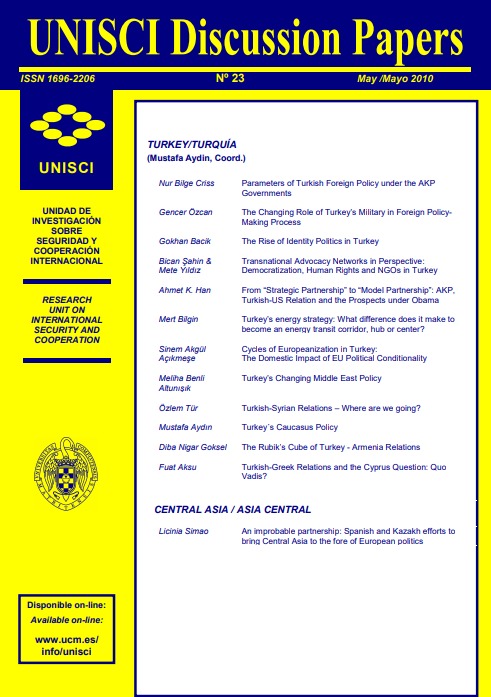 Fuat Aksu,"Turkish-Greek Relations and the Cyprus Question: Quo Vadis?" UNISCI Discussion Papers, Nº 23 (May / Mayo 2010), pp. 207-223.
Abstract:
It can be claimed that the most disruptive factor in the intransigent relations between Turkey and Greece is the absence of a platform for dialogue and negotiation where constructive relations might be developed. The efforts made towards dialogue and negotiation, initiated from time to time, were inadequate given the absence of trust and security between the two countries. The process of moderate dialogue and confidence building measures initiated after the crisis of the 1990s created the basis for the bilateral détente in 1999. During this period, once the EU conferred candidate status on Turkey, the questions between Turkey and Greece were moved from the traditional sphere to the European platform. In other words, relations and disputes were “Europeanized”. In the post-1999 period, bilateral relations were developed under the axis of conditionality and Europeanization. Even though this situation created an appropriate basis for the development of dialogue and cooperation, it was not able to mark an improvement in solving the fundamental questions. In particular, the acceptance of the Greek Cypriots into the European Union despite their rejection of the Annan Plan altered the balance against Turkish Cypriots and Turkey, and thus Turkish criticism of the European Union increased. The détente process reinforced the opinion that it was possible to live with the over-securitized problems of the past and increase the level of tolerance in bilateral realtions. However, tense relations which the “European anchor” can prevent at present might take shape in the foreseeable future, if the European Union cannot provide full membership to Turkey.
Keywords: Turkish – Greek relations, Cyprus, Détente, Europeanization.
- Görüntüleme: 631
Fuat Aksu,“Türkiye – Avrupa Birliği Tam Üyelik Müzakerelerinde Kıbrıs Ve Ege Uyuşmazlıkları”, Türkiye – AB İlişkileri: Dış Politika ve İç Yapı Sorunsalları, Mehmet Seyfettin Erol ve Ertan Efegil (Der.), Ankara: Alp Yay.,2007, ss.25-59.
- Görüntüleme: 708

Türkiye açısından Avrupa Birliği’nin bir aktör olarak Türk-Yunan ilişkilerinde etkinliğini göstermesi bu ülkenin 1981 yılından itibaren örgüte tam üye olmasıyladır. 1981 yılında Yunanistan’ın Avrupa Birliği’ne (AET) tam üye olarak katılmasıyla birlikte Avrupa Birliği (AB)’nin sınırları Ege ve Akdeniz’in ortalarını da kapsar hale gelmiştir. Ancak bu dönemden Türkiye’nin Avrupa Birliği’ne aday ülke olarak kabul edilmesine kadar geçen sürede Avrupa Birliği Türkiye ile Yunanistan arasındaki uyuşmazlıklarda doğrudan bir aktör olma statüsünü elinde bulunduramamıştır. Her ne kadar 1995-1996 tarihli Gümrük Birliği ile bir koşulluluk ilişkisi başlatılmış ise de bunun siyasi ilişkilere yansıması Kıbrıs ile sınırlı kalmıştır.
Devamını oku: Fuat Aksu, "Doğu Akdeniz Deniz Yetki Alanları Sorunu ve Türkiye - AB İlişkileri"
- Görüntüleme: 611

Fuat Aksu, "Uyuşmazlık-Kriz Sarmalından Algı Değişimine Türkiye-Yunanistan İlişkileri", Mustafa Kaymakçı ve Cihan Özgün (Ed.), Rodos ve İstanköy Türklüğü, İzmir: RİOTKDD Yay., 2014, ss. 55-90.
- Görüntüleme: 576

- Görüntüleme: 625
Cite: Fuat Aksu and Helin Sarı Ertem, "Introduction: Assessing the Turkish Foreign Policy Crises and Crisis Management in the Republican Era", in Analysing Foreign Policy Crises in Turkey: Conceptual, Theoretical and Practical Discussions, Fuat Aksu and Helin Sarı Ertem (Eds.), (Cambridge: Cambridge Scholars Publishing, 2017): 1-16.
Assessing the Turkish Foreign Policy Crises and Crisis Management in the Republican Era*
Fuat Aksu and Helin Sarı Ertem
Considering the currently marked rise that takes place both in the number and variety of actors the international community is made up of, a decision on an important matter is made almost at any moment by those in charge who have the authority to make decisions in the name the of state. For the sake of making the best possible decision for the country’s interests, the political decision-maker should often take multiple options and possibilities into consideration. In a democratic state, a decision made by a political decision-maker is supposed to have a political consequence. Therefore, with the decision that he/she makes, the political decision-maker shapes his/her political fate as well.
- Görüntüleme: 783
Cite: Helin Sarı Ertem, "Reflections of Beliefs and Worldviews of the Turkish Ruling Elite on the Syria Crisis", in Analysing Foreign Policy Crises in Turkey: Conceptual, Theoretical and Practical Discussions, Fuat Aksu and Helin Sarı Ertem (Eds.), (Cambridge: Cambridge Scholars Publishing, 2017): 112-142.
Reflections of Beliefs and Worldviews of the Turkish Ruling Elite on the Syria Crisis*
Helin Sarı Ertem
Introduction
A crisis situation in foreign policy is a process that threatens national values and interests, and usually obliges the decision-makers to make their decisions in a rapid way. It can also lead to a problem of survival for the states, if not well-managed. The basic aim in the crisis management is to protect the national targets and interests without going to a war.[1] In the international relations, a crisis is a situation of disagreement, which is possible to solve but can also turn into a war.[2] With these characteristics, the recent Turkey-Syria tension, which has been going on since the beginning of the Syrian civil war in 2011, can also be considered as a crisis situation that, in the eyes of the Turkish decision makers, threatens Turkey’s national interests and even survival. It is closely related not only to the changing regional circumstances but also the domestic and systemic factors.
Devamını oku: Reflections of Beliefs and Worldviews of the Turkish Ruling Elite on the Syria Crisis


- Görüntüleme: 604

- Görüntüleme: 652
Helin Sarı Ertem, “Partners in Conflict: The PKK Issue in Turkish – American Relations”, Turkish Review of Middle East Studies, Annual 2006, 17, pp. 57-92.
- Turkish-American Relations and Northern Iraq: Relief At Last?
- Arab Spring and the Regionalization of the Kurdish Problem - Possible Outcomes for Turkey and the GCC
- Kuzey Irak'tan 'Irak Kürdistanı'na Ankara-Erbil İlişkilerindeki Dönüşümün Siyasi ve Ekonomik Temelleri
- Türk Dış Politikasında Bir Lider SÜLEYMAN DEMİREL
- Aydın Şıhmantepe, "Kardak Krizi Sürecinin Kriz Yönetim Prensipleri Açısından İncelenmesi"
- An Integrated Model Proposal for Analysing Turkish Foreign Policy Crises
- Turkish Amphibious Operations During the Cyprus War of 1974
- Türkiye - Ermenistan İlişkilerinde Nahçıvan Sorunu
- Küçük Ağrı Krizi: Türkiye-İran İlişkilerinde Bir Kriz Yönetimi Örneği
- Border Security in Turkish Foreign Policy Crises
- DIŞ POLİTİKA KRİZİ TETİKLEYİCİSİ OLARAK SİVİL TOPLUM KURULUŞLARI: MAVİ MARMARA ÖRNEĞİ
- Insights of the Mavi Marmara Confrontation: Analysing the Turkish Crisis Management Process
Alt kategoriler
Gencer Özcan Makaleler Makale Sayısı: 5
Gencer Özcan Makaleler
Fuat Aksu Makaleler Makale Sayısı: 30
Fuat Aksu Makaleler
Helin Sarı Ertem Makaleleri Makale Sayısı: 10
Aydın Şıhmantepe Makaleler Makale Sayısı: 3
Aydın Şıhmantepe Makaleler
Serhat Güvenç Makaleler Makale Sayısı: 1
Serhat Güvenç Makaleler
Laçin İdil Öztığ Makaleler Makale Sayısı: 3
Laçin İdil Öztığ Makaleler
Tuğçe Kafdağlı Makaleler Makale Sayısı: 3
Tuğçe Kafdağlı Makaleler
Ayşe Küçük Makaleler Makale Sayısı: 4
Ayşe Küçük Makaleler
Zehra Gürsoy Makaleler Makale Sayısı: 2
Zehra Gürsoy Makaleler
Ümran Üçbaş Makaleler Makale Sayısı: 1
Ümran Üçbaş Makaleler
Süleyman Güder Makaleler Makale Sayısı: 1
Süleyman Güder Makaleler